
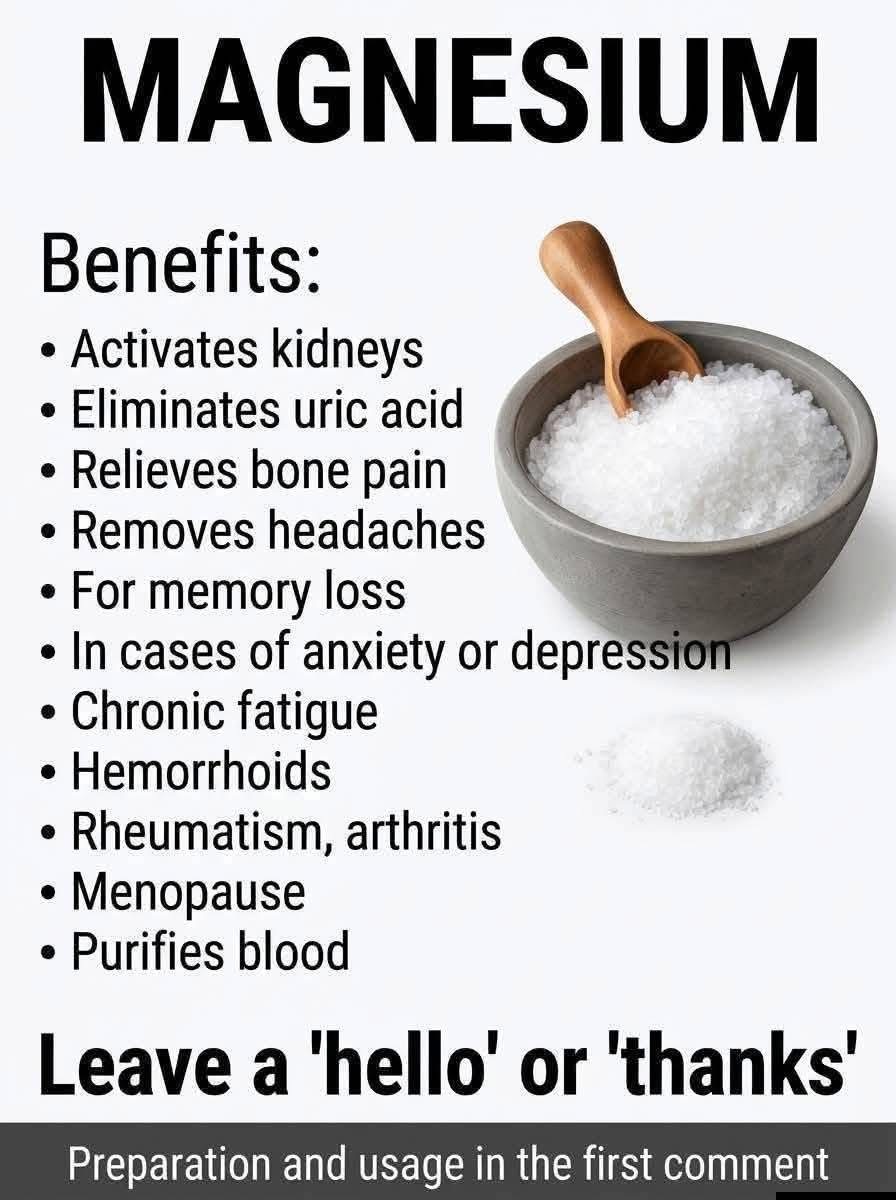
Magnesium is an essential mineral involved in muscle and nerve function, energy production, bone health, blood glucose regulation, and normal heart rhythm. The image, however, attributes a much broader list of effects to “magnesium,” including eliminating uric acid, treating hemorrhoids, depression, arthritis, menopause, and “purifying the blood.”
Those claims need some clarification. Magnesium is important for normal body function, but magnesium is not a general detox treatment or a cure for these conditions. The form of magnesium also matters: magnesium found in food, an oral supplement, and magnesium salts used in baths are not interchangeable.
📋 Magnesium Overview
| Category | Details |
| Mineral | Magnesium |
| Main role | Supports hundreds of biochemical processes |
| Food sources | Nuts, seeds, legumes, whole grains, leafy greens |
| Supplement forms | Citrate, chloride, lactate, aspartate, oxide, etc. |
| Main body functions | Muscles, nerves, bones, energy metabolism, blood glucose and blood pressure regulation |
| Best approach | Obtain magnesium primarily from a varied diet |
💚 Why Magnesium Is Important
Magnesium participates in more than 300 enzyme systems and contributes to protein synthesis, muscle and nerve function, energy production, blood glucose regulation, blood pressure regulation, and normal heart rhythm.
Good dietary sources include:
- 🌰 Almonds and other nuts
- 🌻 Sunflower seeds
- 🎃 Pumpkin seeds
- 🌱 Legumes
- 🌾 Whole grains
- 🥬 Spinach and other leafy greens
- 🥑 Avocado
- 🥣 Some fortified foods
- 🥛 Milk and yogurt
🔍 What About the Claims in the Image?
🫘 “Activates the kidneys”
Magnesium does not need to be used to “activate” healthy kidneys. In fact, the kidneys are important in maintaining magnesium balance because they regulate how much magnesium is excreted in urine.
💧 “Eliminates uric acid”
This is not an established treatment for high uric acid or gout. Magnesium should not be used as a substitute for appropriate medical evaluation or gout treatment.
🦴 “Relieves bone pain”
Magnesium is important for healthy bones, but that does not mean taking magnesium will automatically relieve unexplained bone pain. Persistent bone pain should be evaluated to determine its cause.
🤕 “Removes headaches”
There is more nuance here. Research suggests magnesium supplementation may modestly reduce migraine frequency, and professional guidelines have considered magnesium probably effective for migraine prevention. However, this is not the same as saying magnesium removes all headaches.
🧠 “Memory loss”
Magnesium is involved in normal nervous-system function, but there isn’t enough evidence to say magnesium supplements treat memory loss.
😌 “Anxiety or depression”
Magnesium is important for normal neurological function, but the image’s claim that magnesium treats anxiety or depression is too broad. It should not replace evidence-based treatment for these conditions.
😴 “Chronic fatigue”
Magnesium deficiency can cause symptoms such as fatigue and weakness, but fatigue has many possible causes. Treating magnesium deficiency is different from treating unexplained chronic fatigue.
🩺 “Hemorrhoids”
There is no established evidence that magnesium cures hemorrhoids. Magnesium-containing laxatives may sometimes affect bowel movements, but that is different from treating hemorrhoidal disease.
🦵 “Rheumatism and arthritis”
Magnesium is involved in muscle and bone function, but magnesium supplementation isn’t an established cure for arthritis.
🌸 “Menopause”
Magnesium is an essential nutrient, but the image’s broad claim that it treats menopause is not supported by sufficient evidence.
🩸 “Purifies the blood”
“Blood purification” is not a recognized medical function of magnesium. The body already has organs—including the liver and kidneys—that perform essential waste-processing and elimination functions.
🧂 What Is the White Powder in the Picture?
The image appears to show a white crystalline magnesium salt, but the photograph alone isn’t enough to determine exactly which magnesium compound it is.
This is important because different products can contain different forms of magnesium, such as:
- Magnesium chloride
- Magnesium citrate
- Magnesium sulfate
- Magnesium oxide
- Magnesium lactate
They have different uses and absorption characteristics.
Don’t consume an unidentified white powder simply because an online image calls it “magnesium.”
🍽️ The Best Way to Get Magnesium
For most people, food is the preferred source.
🌰 Magnesium-Rich Foods
| Food | Practical Serving |
| Pumpkin seeds | 1 oz |
| Almonds | 1 oz |
| Spinach | 1 cup cooked |
| Black beans | 1 cup cooked |
| Whole grains | Varies |
| Chia seeds | 1 oz |
| Cashews | 1 oz |
| Yogurt | 1 serving |
A varied diet containing nuts, seeds, legumes, whole grains, and green vegetables can provide substantial magnesium.
💊 What About Magnesium Supplements?
Magnesium supplements can be useful when dietary intake is inadequate or when a healthcare professional recommends supplementation.
Common forms include magnesium citrate, chloride, lactate, and aspartate.
However, more isn’t necessarily better.
For adults, the upper limit for magnesium from supplements and medications is 350 mg/day, unless a healthcare professional recommends otherwise. This limit does not apply to magnesium naturally present in food.
Too much supplemental magnesium can cause:
- Diarrhea
- Nausea
- Abdominal cramping
Extremely high amounts can cause serious toxicity, particularly in people with impaired kidney function.
⚠️ Important Medication Interactions
Magnesium supplements can interfere with the absorption of certain medications, including:
- Some antibiotics
- Oral bisphosphonates used for osteoporosis
Some medications, including certain diuretics and long-term proton-pump inhibitors, can also affect magnesium levels.
If you’re taking prescription medication regularly, check with a doctor or pharmacist before starting a magnesium supplement.
🛁 What About Magnesium Baths?
If the product pictured is intended for bathing rather than eating, do not assume that soaking in it provides the same nutritional benefits as taking magnesium orally.
A bath product should be used according to its specific label instructions. It should not be consumed unless the product is specifically manufactured and labeled for oral use.
❓ Frequently Asked Questions
Does magnesium remove uric acid?
There is no established evidence that magnesium is a treatment that simply removes excess uric acid.
Can magnesium cure headaches?
Not all headaches. Some research supports magnesium as a possible option for migraine prevention, but supplementation for this purpose should be discussed with a healthcare professional.
Can magnesium treat arthritis?
Magnesium is important for normal bone and muscle function, but it isn’t an established cure for arthritis.
Can magnesium detoxify the blood?
No. “Blood purification” is not an established medical benefit of magnesium.
Is magnesium good for the kidneys?
Magnesium balance is closely regulated by the kidneys, but that does not mean taking extra magnesium improves kidney function. People with impaired kidney function need particular caution because they may have difficulty eliminating excess magnesium.
Can I take magnesium every day?
Some people can safely take a magnesium supplement, but the appropriate amount depends on dietary intake, the form of magnesium, medications, and individual health. High-dose supplementation should not be started without appropriate guidance.
🌿 Final Thoughts
Magnesium is genuinely an essential mineral with important roles throughout the body, particularly in muscle and nerve function, energy metabolism, bone health, and normal cardiovascular function.
But the viral list in the image goes far beyond what the evidence supports. Magnesium should not be promoted as a way to “purify the blood,” eliminate uric acid, cure hemorrhoids, treat arthritis, or cure depression or memory loss.
For general wellness, focus first on magnesium-rich foods such as seeds, nuts, beans, whole grains, and leafy green vegetables. If you are considering a magnesium supplement for a particular health problem—especially migraine—it’s best to discuss the appropriate form and dose with a healthcare professional.
⚠️ If you have kidney disease, take regular medication, are pregnant or breastfeeding, or are considering high-dose magnesium, consult a healthcare professional before using magnesium supplements.