
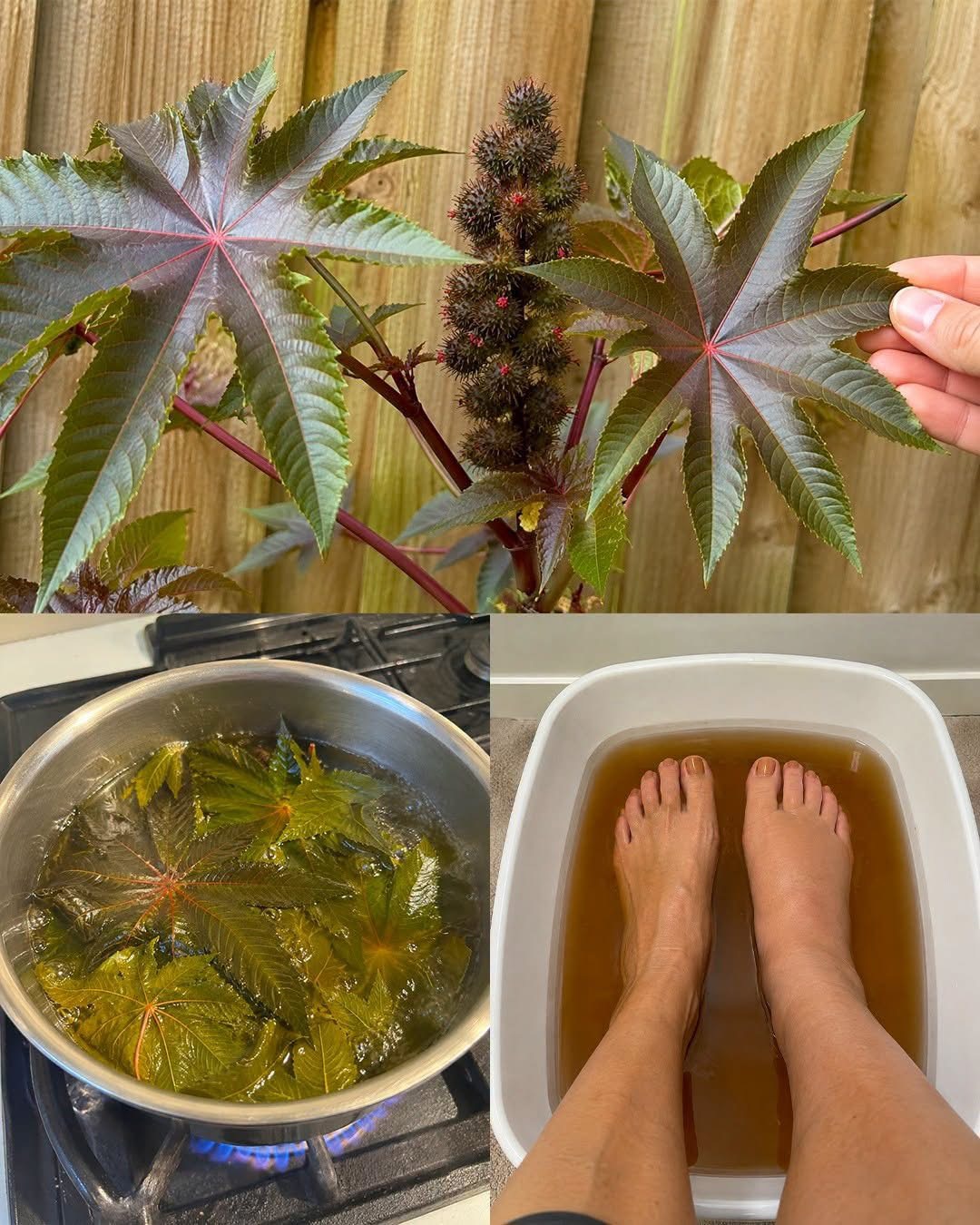
Castor leaves (Ricinus communis) have a long history in traditional medicine, and laboratory research has identified several biologically active compounds in the plant. However, many claims circulating online present traditional uses or laboratory findings as if they were proven treatments in humans.
That distinction is important. Research has reported antioxidant, anti-inflammatory, antimicrobial, and other activities from castor-leaf extracts, but much of this evidence comes from laboratory or preclinical studies rather than well-controlled human clinical trials.
Most importantly, castor leaves should not be treated as a general-purpose home remedy, and homemade teas, extracts, or preparations should not be consumed.
🌿 1. Traditional Use for Joint & Muscle Discomfort
Castor leaves have traditionally been used externally for conditions involving pain, inflammation, and muscle discomfort. Reviews of Ricinus communis describe traditional applications including arthritis, backache, muscle aches, sciatica, rheumatism, and menstrual cramps.
However, traditional use does not establish that placing a warm leaf on painful joints actually treats arthritis or other underlying conditions.
Evidence level: Traditional/preclinical evidence; not established as a clinical treatment.
🌱 2. Anti-Inflammatory Potential
Laboratory research has found anti-inflammatory activity in extracts prepared from castor leaves. One study tested several leaf extracts in laboratory models and reported antioxidant and anti-inflammatory activity.
This is scientifically interesting, but a laboratory extract is not equivalent to a homemade leaf compress.
Important: Laboratory activity does not prove that castor leaves safely reduce inflammation in people.
🩹 3. Wound-Healing Claims
Castor plant preparations have traditionally been used for wounds, sores, and boils, and researchers have investigated antimicrobial and wound-healing properties of the plant.
Nevertheless, fresh castor leaves should not be placed directly on an open wound. Homemade plant preparations are not sterile and could introduce bacteria or irritate damaged skin.
For cuts and wounds, appropriate cleaning and evidence-based wound care are safer options.
🌸 4. Menstrual Cramps
Traditional medicine has used different parts of the castor plant for menstrual discomfort.
However, there is not sufficient clinical evidence to recommend castor leaves as a treatment for menstrual cramps.
For persistent, severe, or newly occurring menstrual pain, the underlying cause should be evaluated rather than relying on an herbal preparation.
💇♀️ 5. Hair & Scalp Health
Online posts sometimes recommend boiled castor leaves as a scalp rinse for dandruff or hair growth.
There is not enough clinical evidence to establish castor-leaf rinses as a hair-growth treatment. Research into castor leaves includes laboratory investigations of their biological activity, but that is different from demonstrating increased hair growth in humans.
For persistent dandruff or hair loss, evidence-based treatments are preferable.
🤱 6. Breastfeeding & Breast Engorgement
Castor leaves have been used traditionally as a poultice or compress for breastfeeding-related problems, including claims of increasing milk production.
However, there are no scientifically valid clinical trials supporting castor leaves as a galactagogue, according to LactMed’s review of castor. It also notes that safety information for castor-plant preparations in breastfeeding mothers and infants is lacking.
Therefore, castor leaves should not be recommended to increase breast milk supply.
Breastfeeding mothers with painful engorgement, blocked ducts, fever, or breast redness should seek appropriate lactation or medical care.
🦶 7. Swelling & Inflammation
Traditional sources describe external use of castor leaves for inflammatory complaints.
But there isn’t enough human evidence to conclude that a castor-leaf compress reliably reduces swelling from sprains, insect bites, arthritis, or other conditions.
Sudden or unexplained swelling—particularly if accompanied by severe pain, redness, warmth, fever, or shortness of breath—needs medical assessment.
🫁 8. Respiratory Problems
Some traditional-medicine literature reports castor plant preparations for respiratory and other ailments, but this does not establish that inhaling steam from boiled castor leaves treats congestion, coughs, bronchitis, or lung disease.
I would particularly avoid recommending homemade castor-leaf steam inhalation because there is no established safe preparation or therapeutic dose.
🧴 9. Skin Conditions
Laboratory research has found antimicrobial and anti-inflammatory activity in castor-leaf extracts, which has led to interest in their possible dermatological applications.
But there is insufficient clinical evidence to recommend homemade castor-leaf preparations for eczema, ringworm, acne, or skin infections.
For suspected fungal or bacterial infections, proper diagnosis matters because different infections require different treatments.
🍵 10. Digestion & Constipation
Traditional medicine has used various parts of the castor plant for digestive complaints and constipation.
However, castor-leaf tea should not be recommended as a laxative or digestive treatment.
This is particularly important because homemade preparations can vary substantially in composition and concentration, making their safety unpredictable.
⚠️ The Most Important Safety Information
🌱 Castor leaves are not the same as castor oil
The castor plant contains many different compounds, and the seeds are the major source of the highly toxic protein ricin. CDC identifies ricin as a natural poison found in castor beans.
Commercially manufactured castor oil is processed differently from homemade preparations made from the plant.
🚫 Don’t make castor-leaf tea
There is no established safe medicinal dose for drinking castor-leaf preparations. Avoid homemade teas, extracts, or concentrated preparations.
🚫 Don’t use fresh leaves on open wounds
Plant material isn’t sterile, and damaged skin is more vulnerable to irritation and infection.
🚫 Don’t use it during breastfeeding without medical advice
There is insufficient evidence about the safety and effectiveness of castor-plant preparations for nursing mothers and infants.
🚫 Don’t assume boiling makes it safe
Home cooking or boiling should not be considered a reliable method for turning a medicinal plant into a safe medicine.
🔬 What Does the Science Actually Show?
The most accurate way to describe castor leaves is:
Interesting traditional medicine + promising laboratory research ≠ proven human treatment.
For example, researchers have demonstrated antioxidant and anti-inflammatory activity from castor-leaf extracts in laboratory experiments. Other research has investigated antimicrobial and antiviral activity.
But these studies don’t establish that drinking castor-leaf tea, applying crushed leaves, or taking homemade extracts will safely treat disease in humans.
A 2026 review of traditional medicinal plants used for maternal conditions also illustrates the broader problem: only a small proportion of the plants examined had scientific evidence supporting their traditional uses, while safety data were limited for many others.
❓ Frequently Asked Questions
Can I drink castor-leaf tea?
It is not recommended. There is no established safe medicinal dose or adequate evidence supporting its use for treating health conditions.
Can castor leaves cure arthritis?
No. Castor leaves have traditional use for inflammatory and musculoskeletal complaints, but this does not establish them as a treatment or cure for arthritis.
Can castor leaves make hair grow?
There isn’t sufficient human clinical evidence to support castor-leaf rinses as a hair-growth treatment.
Can breastfeeding mothers use castor leaves?
Because evidence regarding safety and effectiveness is inadequate, breastfeeding mothers should discuss any castor-plant preparation with a healthcare professional rather than using it independently.
Are castor leaves poisonous?
The castor plant requires caution, particularly because its seeds contain ricin. CDC describes ricin as an extremely toxic substance associated with castor beans.
Is castor oil the same as castor-leaf extract?
No. They are different preparations and should not be assumed to have the same safety profile or medical effects.
🌿 Final Thoughts
Castor leaves have a fascinating history in traditional medicine, and scientific studies have identified antioxidant, anti-inflammatory, antimicrobial, and other biological activities in castor-leaf extracts.
But claims that castor leaves can heal wounds, cure arthritis, increase breast milk, grow hair, treat infections, improve digestion, or relieve respiratory disease go beyond what current human evidence can establish.
The safest approach is to view castor leaves as a plant with interesting traditional and laboratory research—not as a proven home medicine. In particular, avoid consuming homemade castor-leaf preparations or using them on wounds or during breastfeeding without professional guidance.
⚠️ This information is not a substitute for medical care. If you have persistent pain, an infection, unexplained swelling, severe menstrual symptoms, breastfeeding difficulties, or another medical problem, consult a healthcare professional rather than relying on castor leaves.