
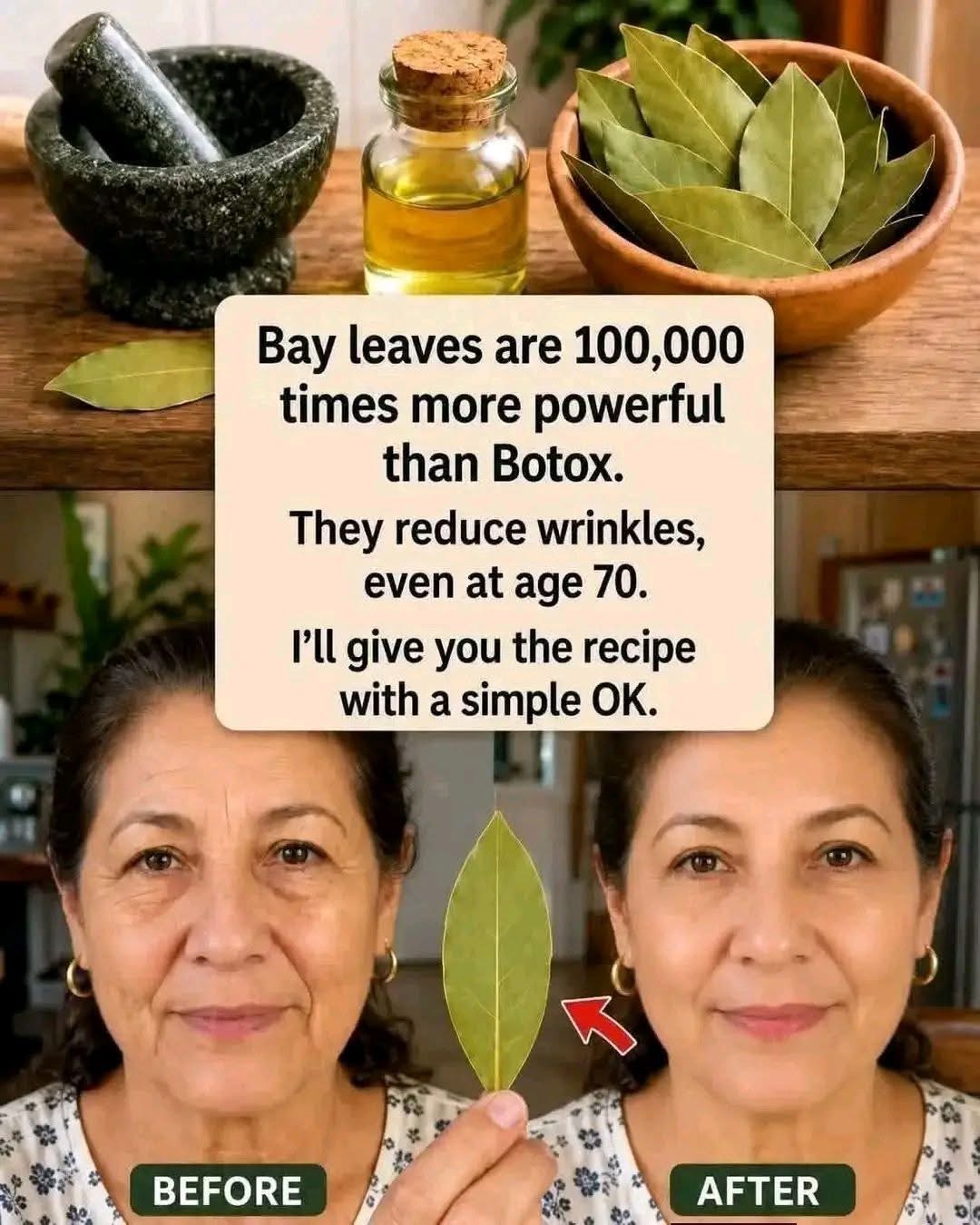
A viral skincare claim says that bay leaves are “100,000 times more powerful than Botox” and can dramatically reduce wrinkles—even in older skin.
That comparison is not supported by clinical evidence. Bay leaves (Laurus nobilis) contain plant compounds with antioxidant activity, and researchers are investigating their potential cosmetic uses. However, laboratory research on a specially formulated bay-leaf hydrosol hydrogel does not show that ordinary bay-leaf water, fresh leaves, or homemade extracts can erase facial wrinkles.
There is also an important difference between a promising laboratory ingredient and a proven anti-aging treatment.
🌿 What the Research Actually Shows
A 2026 study investigated Laurus nobilis hydrosol in a specially formulated hydrogel. Researchers reported antioxidant activity, physical and microbiological stability of the formulated gel, and an occlusive effect that helped maintain hydration in laboratory testing. The study also used an in-vitro human keratinocyte model.
That is interesting research, but it does not establish that rubbing bay leaves or homemade bay-leaf water onto your face reduces wrinkles in humans.
The distinction is important:
“A plant contains antioxidant compounds”
does not automatically mean
“the plant removes wrinkles.”
A wrinkle-reducing claim requires appropriate human clinical evidence.
💉 Bay Leaves Are Not Equivalent to Botox
Botox and bay leaves work in completely different ways.
Botulinum toxin treatments are medical procedures designed to temporarily reduce activity in specific muscles. Bay leaves have no established equivalent effect.
So there is no scientific basis for saying bay leaves are “100,000 times stronger than Botox.”
🧴 Should You Put Bay Leaves Directly on Your Face?
I wouldn’t recommend rubbing fresh bay leaves, concentrated bay-leaf juice, essential oil, or a strong homemade extract directly onto facial skin simply to treat wrinkles.
The problem isn’t that bay leaves are inherently useless as a culinary herb. The problem is that a homemade preparation has an unknown concentration, formulation, stability, and irritation potential.
For skincare, a properly formulated commercial product is generally more predictable than a homemade botanical mixture.
The American Academy of Dermatology also recommends testing new skincare products on a small area first and stopping if the product causes burning or irritation.
✨ What Can Actually Help With Wrinkles?
1. ☀️ Broad-Spectrum Sunscreen
Sun protection is one of the most important parts of preventing premature skin aging.
The American Academy of Dermatology recommends sunscreen providing broad-spectrum protection and SPF 30 or higher. UV exposure contributes to wrinkles and other signs of premature skin aging.
For everyday use, sunscreen should be applied to exposed skin and reapplied as directed, particularly during prolonged outdoor activity.
2. 💧 Moisturizer
A good moisturizer can temporarily make fine lines appear less noticeable because it increases the skin’s water content and gives the surface a smoother, plumper appearance.
This is different from permanently removing wrinkles.
3. 🌙 Retinoids and Retinol
Retinoids have considerably more evidence behind them for addressing fine lines and wrinkles than homemade bay-leaf remedies.
The AAD explains that retinoids can increase skin-cell turnover and stimulate collagen production, helping improve fine lines, wrinkles, pigmentation, and skin texture.
Retinoids can also cause irritation, so introducing them gradually and following product directions is important.
4. 🍊 Vitamin C
Vitamin C is another evidence-based skincare ingredient used for concerns such as skin aging and uneven pigmentation. The AAD notes that vitamin C products can help address signs of skin aging and dark spots.
5. 🧴 A Simple Skincare Routine
For many people, an uncomplicated routine is easier to maintain:
Morning
- Gentle cleanser
- Moisturizer
- Broad-spectrum SPF 30+
Evening
- Gentle cleanser
- Retinol/retinoid if appropriate
- Moisturizer
You don’t need a complicated collection of products to build a sensible anti-aging skincare routine.
🌿 What About Bay Leaf Water?
Could a properly formulated bay-leaf preparation have moisturizing or antioxidant properties?
Possibly—but that’s still an area of research.
The 2026 study is interesting because it examined a standardized Laurus nobilis hydrosol incorporated into a formulated hydrogel, not a homemade bowl of boiled bay leaves. The researchers specifically investigated formulation properties, stability, antioxidant activity, and laboratory behavior.
So it would be misleading to take those findings and conclude:
“Boil bay leaves, put the water on your face, and wrinkles disappear.”
The research does not demonstrate that.
❓ Frequently Asked Questions
Can bay leaves remove wrinkles?
There is currently no good clinical evidence demonstrating that fresh bay leaves, bay-leaf water, or homemade bay-leaf preparations remove facial wrinkles.
Are bay leaves really 100,000 times more powerful than Botox?
No credible clinical evidence supports that comparison.
Can bay-leaf water temporarily make skin look smoother?
Any properly moisturizing preparation may temporarily make skin look smoother by increasing hydration, but that doesn’t demonstrate an anti-wrinkle treatment effect. The 2026 bay-leaf hydrogel research involved a specially formulated product and laboratory testing.
Can I rub a fresh bay leaf directly on my face?
It’s better not to rely on fresh plant material as a wrinkle treatment. There is no established anti-wrinkle benefit, and untested botanical preparations can irritate the skin.
What is better for preventing wrinkles?
Daily broad-spectrum SPF 30+ sunscreen, moisturizer, and appropriate evidence-based ingredients such as retinoids/retinol have substantially stronger dermatological support.
Can a moisturizer actually remove wrinkles?
No. Moisturizers can temporarily make some fine lines less noticeable by hydrating and plumping the skin. They don’t permanently erase wrinkles.
Does natural mean safer for the face?
Not necessarily. A plant-derived ingredient can still irritate skin. What matters is the ingredient, concentration, formulation, and how the individual skin responds.
🌿 Final Thoughts
Bay leaves are a useful culinary herb and contain interesting plant compounds that researchers are exploring for potential cosmetic applications. A 2026 laboratory study of a formulated Laurus nobilis hydrosol hydrogel provides interesting early research, but it does not prove that homemade bay-leaf remedies can remove facial wrinkles.
The viral statement that bay leaves are “100,000 times more powerful than Botox” should therefore be treated as an unsupported social-media claim, not an established skincare fact.
If your goal is healthier, younger-looking skin, the better-supported basics are much less dramatic: daily sun protection, moisturizer, gentle skincare, and evidence-based anti-aging ingredients when appropriate. The AAD specifically emphasizes sunscreen and moisturizer as foundational anti-aging measures.
And remember: dramatic before-and-after photos on social media aren’t reliable evidence by themselves. Lighting, makeup, facial expression, camera angle, hydration, and image editing can all change how skin looks.