
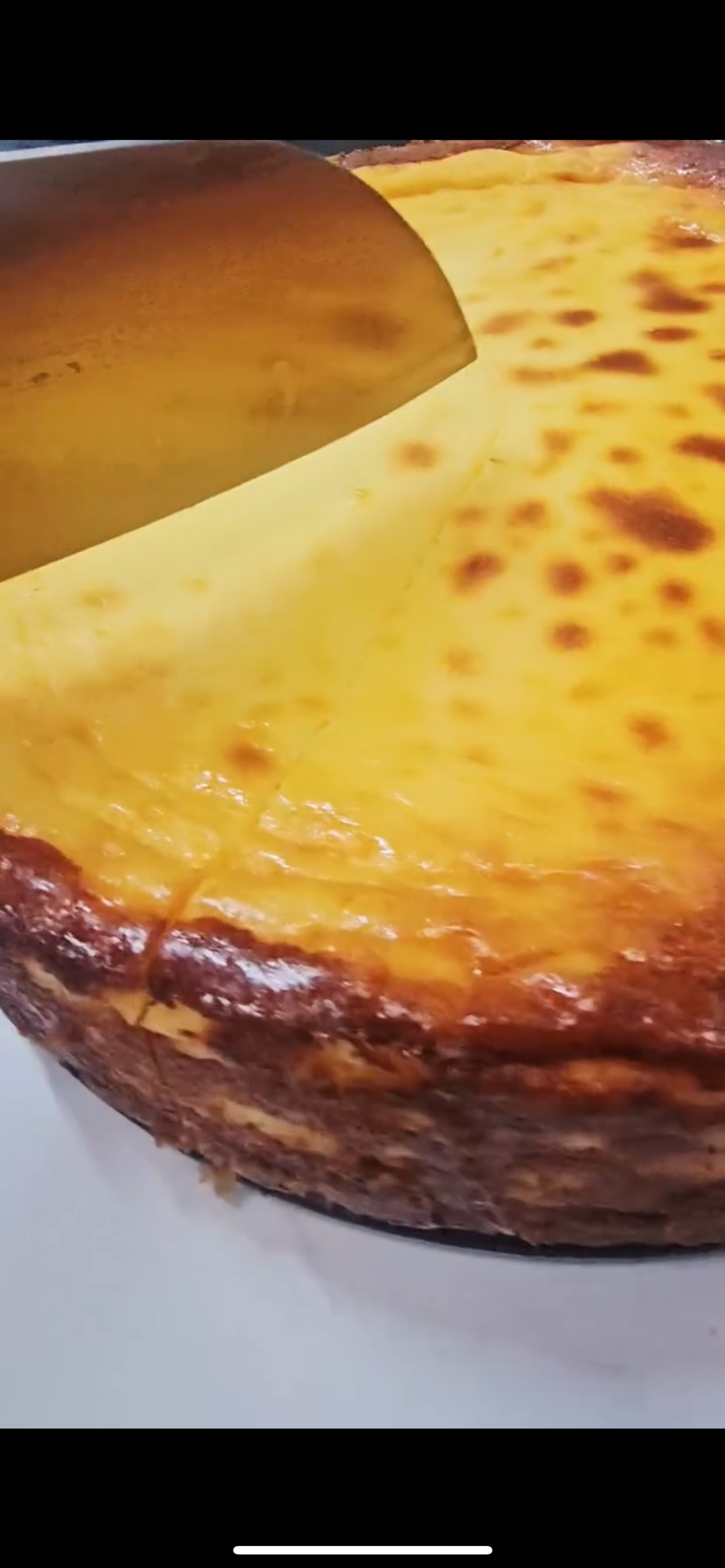
This Basque Burnt Cheesecake is rich, creamy, and wonderfully indulgent, with a beautifully caramelized top and a soft, custard-like center. Unlike traditional cheesecake, it is baked at a high temperature without a crust, allowing the surface to develop those signature deep golden-brown spots while the middle stays silky and luscious.
Recipe Overview
| Detail | Information |
| Prep Time | 15 minutes |
| Cook Time | 40–50 minutes |
| Cooling Time | 2–3 hours |
| Total Time | About 3 hours |
| Servings | 8–10 slices |
| Difficulty | Easy |
| Oven Temperature | 425°F (220°C) |
Why You’ll Love This Recipe
- 🧀 Ultra-creamy center with a smooth, rich texture.
- 🔥 Beautiful caramelized top with classic burnt cheesecake spots.
- 🍰 No crust required, making preparation quick and simple.
- 🥛 Uses simple ingredients you can find in most grocery stores.
- ✨ Perfect served chilled or slightly softened at room temperature.
- ☕ Delicious with coffee, tea, or fresh berries.
Ingredients
Cheesecake
| Ingredient | Amount |
| Full-fat cream cheese, softened | 680 g (24 oz) |
| Granulated sugar | 200 g (1 cup) |
| Large eggs | 4 |
| Heavy cream | 300 ml (1¼ cups) |
| All-purpose flour | 30 g (¼ cup) |
| Vanilla extract | 1 tsp |
| Salt | ¼ tsp |
For the Pan
| Ingredient | Amount |
| Parchment paper | Enough to line the pan |
| Butter or nonstick spray | For the pan |
Step-by-Step Instructions
1. Prepare the Pan
Preheat your oven to 425°F (220°C).
Use a 9-inch (23 cm) springform pan. Lightly grease it, then line it generously with parchment paper, allowing the paper to extend several centimeters above the rim.
The parchment should be slightly crinkled rather than perfectly smooth. This gives the cheesecake its characteristic rustic appearance.
2. Beat the Cream Cheese
Place the softened cream cheese and sugar in a large mixing bowl.
Beat on medium speed for about 2–3 minutes, until completely smooth and creamy.
Scrape down the sides of the bowl as needed.
3. Add the Eggs
Add the eggs one at a time, mixing briefly after each addition.
Avoid overmixing once the eggs are incorporated. The goal is a smooth batter without incorporating excessive air.
4. Add the Cream
Pour in the heavy cream and add the vanilla extract and salt.
Mix on low speed until everything is smooth and well combined.
5. Add the Flour
Sift the flour directly into the batter.
Mix gently until no visible flour remains.
The finished batter should be thick, smooth, and pourable.
6. Fill the Pan
Pour the cheesecake batter into the prepared pan.
Gently tap the pan against the counter a few times to release any large air bubbles.
7. Bake
Place the cheesecake in the center of the preheated oven.
Bake for approximately 40–50 minutes.
The top should become deep golden brown with darker caramelized spots, while the center should still have a noticeable jiggle when the pan is gently shaken.
Don’t worry if the cheesecake looks slightly puffed—it will naturally sink as it cools.
8. Cool
Remove the cheesecake from the oven and place it on a wire rack.
Let it cool completely in the pan for at least 2 hours.
For the best texture, refrigerate it for several hours or overnight.
9. Serve
Carefully remove the parchment and transfer the cheesecake to a serving plate.
For clean slices, use a sharp knife warmed under hot water and wiped dry between cuts.
Serve chilled or allow it to sit at room temperature for about 20–30 minutes before serving for an even softer, creamier texture.
Best Tips
Use full-fat cream cheese.
Reduced-fat cream cheese can produce a thinner batter and less luxurious texture.
Bring the cream cheese to room temperature.
Softened cream cheese blends much more easily and prevents lumps.
Don’t overbake.
The center should still jiggle when you remove the cheesecake from the oven. It will continue setting as it cools.
Use plenty of parchment.
The cheesecake rises significantly during baking, so let the parchment extend above the pan.
Don’t worry about the dark top.
The deeply browned surface is the defining feature of Basque cheesecake and gives it a delicious caramelized flavor.
Best Ingredient Options
Cream Cheese
Choose a good-quality full-fat block cream cheese rather than a soft tub-style spread for the most reliable texture.
Heavy Cream
Heavy cream or double cream works beautifully. It helps create the silky, custard-like center.
Sugar
Regular granulated sugar is ideal because it caramelizes beautifully during the high-temperature bake.
Vanilla
Pure vanilla extract gives the cheesecake a subtle aromatic flavor, but vanilla bean paste can also be used.
Recipe Variations
Chocolate Basque Cheesecake
Add 100 g melted dark chocolate to the finished batter for a rich chocolate version.
Lemon Cheesecake
Add the finely grated zest of 1 lemon for a bright citrus flavor.
Berry Cheesecake
Serve individual slices with fresh strawberries, raspberries, or blueberries.
Coffee Cheesecake
Dissolve 1–2 teaspoons instant espresso powder in a tablespoon of warm cream and mix it into the batter.
Salted Caramel
Drizzle cooled slices with homemade or store-bought salted caramel sauce before serving.
What to Serve With
This cheesecake is delicious on its own, but you can also serve it with:
- Fresh berries
- Strawberry sauce
- Raspberry coulis
- Salted caramel
- Chocolate sauce
- Whipped cream
- Fresh fruit
- A cup of coffee or espresso
- Black or green tea
Make-Ahead Instructions
Basque cheesecake is an excellent make-ahead dessert.
Bake it 1–2 days before serving, allow it to cool completely, then refrigerate it covered.
In fact, the flavor and texture often improve after several hours in the refrigerator.
Storage
Store the cheesecake in an airtight container or tightly covered in the refrigerator.
Refrigerated: Up to 4–5 days.
For the best texture, remove it from the refrigerator about 20–30 minutes before serving.
Reheating
Basque cheesecake is generally best served cold or slightly softened at room temperature.
If you prefer it warm, place an individual slice in the microwave for approximately 10–15 seconds.
Be careful not to overheat it, as the creamy center can become runny.
Freezing
You can freeze Basque cheesecake for up to 2 months.
For best results:
- Allow the cheesecake to cool completely.
- Chill it thoroughly.
- Cut it into individual slices.
- Wrap each slice tightly in plastic wrap.
- Place the wrapped slices in a freezer-safe container.
- Thaw overnight in the refrigerator.
Allow thawed slices to sit at room temperature for a few minutes before serving.
Common Mistakes to Avoid
❌ Using cold cream cheese
This can leave lumps in the batter.
❌ Overmixing the batter
Too much air can cause excessive rising and cracking.
❌ Underlining the pan with too little parchment
The batter can leak or rise over the edges.
❌ Baking at a low temperature
The high temperature is essential for creating the characteristic caramelized surface.
❌ Waiting for the center to become completely firm in the oven
A slight jiggle is exactly what you want.
❌ Cutting immediately after baking
The cheesecake needs time to cool and set.
Nutrition Estimate
Approximate values per slice, assuming 10 servings:
| Nutrient | Amount |
| Calories | ~430 kcal |
| Protein | ~7 g |
| Carbohydrates | ~31 g |
| Fat | ~31 g |
| Saturated Fat | ~18 g |
| Sugar | ~25 g |
| Sodium | ~300 mg |
Nutrition values are estimates and can vary depending on the ingredients and serving size.
Frequently Asked Questions
Why is my Basque cheesecake still jiggly?
That’s normal. The center should have a noticeable wobble when it comes out of the oven. It will firm up considerably as it cools and chills.
Why didn’t the top become dark enough?
Your oven may run cooler than its displayed temperature, or the cheesecake may need a few additional minutes. Basque cheesecake is intentionally baked at a high temperature to develop its deeply caramelized surface.
Can I make this without flour?
Yes. The small amount of flour helps stabilize the cheesecake, but you can omit it for an even softer, custard-like texture.
Can I use a different-sized pan?
Yes, but the baking time will change. A smaller, deeper cheesecake will generally need longer, while a wider, shallower cheesecake may bake more quickly.
Should I use a water bath?
No. Unlike traditional New York-style cheesecake, Basque cheesecake is intentionally baked without a water bath at high heat.
Why does the cheesecake sink after baking?
This is completely normal. The cheesecake rises during baking and naturally settles as it cools, creating its characteristic dense, creamy center.
Can I eat it warm?
Yes. It can be enjoyed slightly warm, but chilling gives it a firmer, creamier texture and makes it easier to slice.
Final Thoughts
This easy Basque Burnt Cheesecake is one of the simplest ways to make an impressive homemade dessert. Its deeply caramelized top, golden edges, and irresistibly creamy center make every slice rich and satisfying.
For the best result, remember the key rule: don’t be afraid of the dark top and don’t overbake the center. The contrast between the caramelized exterior and silky interior is exactly what makes this cheesecake so special.